
Formula details
Product Details
Overview
Master the Art of Prototyping with Void-Free Vapour Phase Technology
Are you struggling with trapped voids under complex BGAs? Is your current reflow process risking thermal damage to high-value, heat-sensitive components?
When you are developing advanced electronics, close enough is never good enough. We built our High-Precision Laboratory Vapour Phase Soldering System for R&D and Prototyping to solve the exact thermal challenges engineers face during new product introduction (NPI). This is a compact, high-precision condensation soldering system specifically engineered for R&D labs, advanced packaging chiplet assembly, and zero-defect small-batch production.
Core Capabilities of Our Condensation Soldering System
We bring oxygen-free inert atmosphere reflow directly to your benchtop, ensuring absolute process repeatability without the footprint of a traditional tunnel oven.
- Zero-Defect Soldering: Achieve consistent, void-free soldering for power modules and densely packed QFN/BGA packages.
- Absolute Thermal Safety: Physics-based maximum temperature limits make overheating impossible, effectively preventing the popcorning effect in Moisture Sensitive Devices (MSDs).
- Compact Industrial Power: All the precision of a high-volume manufacturing line condensed into specialized R&D PCB assembly equipment.
- High-Mix Low-Volume (HMLV) Ready: Perfect for rapid iterations, testing functional prototypes, and small batch PCB prototyping.
By utilizing advanced Galden fluid heat transfer, we guarantee superior solder paste wettability and uniform heating across the entire board, regardless of component mass variations or layout density.
Product Overview: The Bridge from Lab to Line
At Jeenoce, we understand that the gap between a concept and a finished product is often defined by the quality of the prototype. Our High-Precision Laboratory Vapour Phase Soldering System is engineered to bridge that gap, bringing the reliability of mass production directly to your workbench. We don't view prototyping as a "rough draft"; we view it as the foundation of manufacturing excellence.
The Core Concept: Miniaturized Industrial Power
This system is not a simplified hobbyist tool; it is a condensed version of our full-scale industrial lines. We have taken the robust thermal stability and void-free capabilities of our larger equipment and packaged them into a footprint suitable for R&D environments. By utilizing advanced condensation heat transfer, we ensure that every board—regardless of complexity—receives uniform heating without the risk of overheating components. This allows engineers to validate processes on a small scale that are fully transferable to our larger industrial vacuum reflow ovens for high-reliability batch production when volume increases.
Target Audience: Who Needs This Precision?
This solution is specifically tailored for professionals who cannot compromise on connection quality, even at the single-unit level.
- R&D Engineers: For validating complex BGA and QFN placements where voiding is a critical failure mode.
- High-Reliability Sectors: Aerospace, Medical, and Automotive labs requiring zero-defect soldering for functional prototypes.
- NPI Managers: Teams handling High-Mix Low-Volume (HMLV) soldering tasks that require frequent profile changes without long setup times.
The Jeenoce Difference: Smart Manufacturing Integration
What sets Jeenoce apart is our commitment to Industry 4.0, even at the laboratory level. We don't just supply hardware; we provide intelligent systems. Our laboratory units are equipped with the same DNA as our turnkey automated production lines.
Key Integration Features:
| Feature | Benefit |
|---|---|
| IoT Connectivity | Real-time monitoring of thermal profiles and fluid levels via cloud analytics. |
| Data Traceability | Automatic logging of every solder cycle, essential for audit trails in regulated industries. |
| AI-Driven Optimization | Smart algorithms that assist in fine-tuning thermal profiles to maximize First Pass Yield (FPY). |
By integrating these smart features, we empower your lab to function as a Smart Factory node, ensuring that data gathered during the prototyping phase seamlessly informs your future mass production strategy.
Key Features & Technological Advantages

At Jeenoce, we engineer our High-Precision Laboratory Vapour Phase Soldering System to bridge the gap between experimental R&D and full-scale manufacturing. We integrate the same robust Industry 4.0 technologies found in our high-volume lines into compact, lab-ready formats.
Physics-Based Thermal Safety
We utilize the physical properties of the heat transfer medium to guarantee component safety. Because the vapour creates an oxygen-free inert atmosphere at a fixed boiling point, it is physically impossible for the assembly to overheat. This "Never Overheat" guarantee is critical when working with expensive, one-of-a-kind prototypes or heat-sensitive components.
Advanced Vacuum Technology
Achieving void-free solder joints is non-negotiable for high-reliability sectors like aerospace and medical electronics. Our systems incorporate advanced vacuum stages that activate when the solder is molten, effectively extracting gas bubbles. This technology mirrors the capabilities of our industrial vacuum reflow soldering ovens, ensuring that your lab results meet the strictest voiding criteria (often <1%).
Intelligent Profiling & Control
We empower your lab with data. Leveraging our expertise in AI and IoT, our systems offer precise control over thermal profiles.
- Real-time Monitoring: IoT-enabled sensors provide continuous feedback on temperature gradients.
- Repeatability: AI-driven optimization ensures that a successful profile for a single prototype can be perfectly replicated for a small batch.
- MES Integration: Seamlessly connect lab data with your wider manufacturing execution systems for full traceability.
Eco-Friendly Fluid Management
Operating costs matter, even in the lab. Our closed-loop design maximizes fluid recovery, significantly reducing the consumption of heat transfer media (like Galden). This not only lowers the Cost of Ownership (COO) but also ensures a clean, safe working environment free from exhaust fumes.
| Feature | Benefit |
|---|---|
| Fixed Boiling Point | Eliminates risk of overheating components. |
| Vacuum Stage | Reduces voids in BGA and QFN assemblies. |
| IoT Sensors | Provides granular data for process optimization. |
| Closed-Loop System | Recycles fluid to reduce waste and operational costs. |
Technical Specifications
We built this high-precision laboratory vapour phase soldering system for R&D and prototyping to deliver industrial-grade reliability in a compact footprint. It is the ideal benchtop vacuum reflow oven for small batch PCB prototyping. If your workflow involves applying precise amounts of solder paste or adhesives before the reflow stage, pairing this unit with a reliable dispensing machine keeps your lab's production consistent and highly controlled.
System Breakdown
| Feature | Specification Details |
|---|---|
| System Footprint | Space-Saving Standalone System (approx. 2.3 m² footprint) |
| Max PCB Dimensions | 500 mm x 540 mm (W x L) with top clearance up to 80 mm |
| Power Requirements | 400V / 3-Phase / 50 Hz (Industrial Power, approx. 16.5 kW) |
| Heat Transfer Medium | Galden Fluid (Patented Injection Principle & Closed-Loop Recovery) |
| Max Soldering Temp | Up to 240°C (Determined by Galden grade, e.g., HS240 for Lead-Free) |
| Vacuum Capability | Optional Vacuum Module (Enables Void-Free Soldering Technology) |
Core Engineering Highlights
- Low Cost of Ownership: Closed-loop fluid recovery ensures minimal medium loss per cycle.
- Cleanroom Compatible: Fully sealed chamber offers zero exhaust reflow lab solutions for sensitive R&D environments.
- Ultimate Versatility: Safely handles high-mass multilayer boards down to delicate flexible printed circuits (FPC) soldering without the risk of overheating.
Application Scenarios
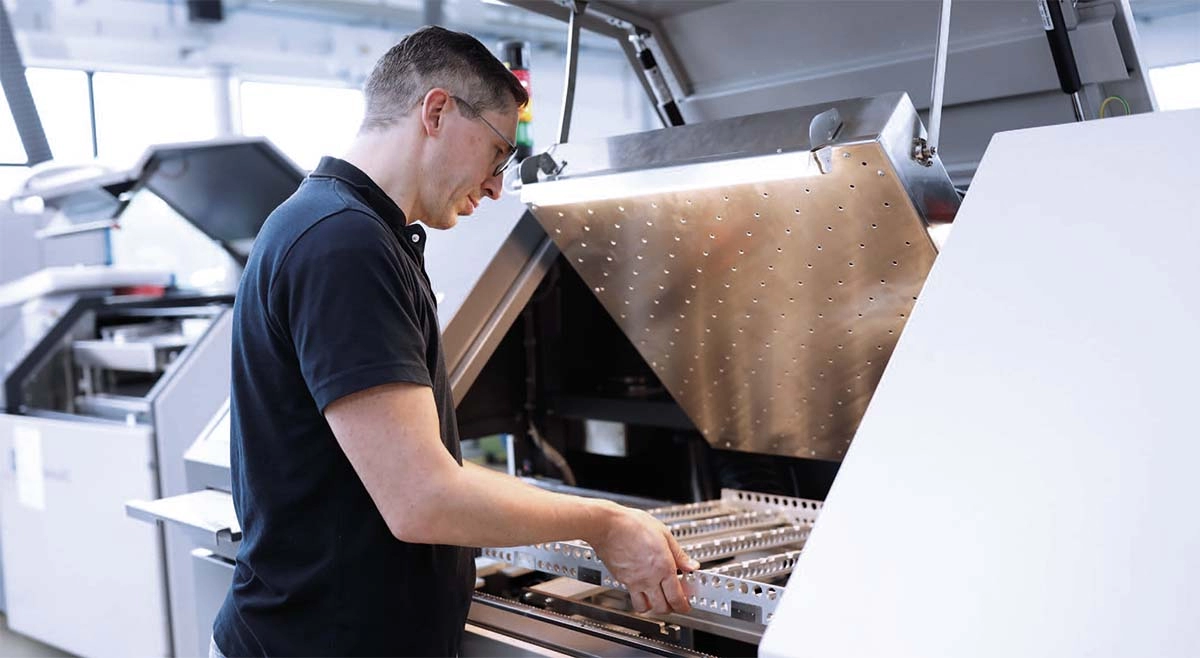
Our High-Precision Laboratory Vapour Phase Soldering System for R&D and Prototyping isn't just a machine; it's a problem solver for the most demanding engineering challenges. We designed this system to handle the specific thermal complexities that standard convection ovens often fail to address in a lab setting.
Scenario A: High-Mass Multilayer Boards
Heavy copper backplanes and thick multilayer PCBs are notoriously difficult to heat evenly. In a standard air or nitrogen oven, the outer layers often burn before the inner layers reach reflow temperature.
- The Challenge: Massive heat sinks causing "cold solder" joints or delamination due to thermal stress.
- The Solution: Our system utilizes Galden Fluid Heat Transfer. The vapour condenses on the assembly, transferring heat precisely where it is cooler.
- The Result: The board heats up uniformly, regardless of its mass or thickness. This ensures perfect wetting on heavy ground planes without overheating sensitive components nearby.
Scenario B: Complex BGA & QFN Assembly
When you are dealing with Advanced Packaging Chiplet Assembly or standard BGAs, you are working blind. The solder joints are hidden beneath the component body, making visual inspection impossible without aid.
- The Challenge: Trapped gas creating voids in the solder joints, leading to field failures.
- The Solution: We integrate Void-Free Soldering Technology using vacuum assistance. By reducing pressure during the liquidus phase, we extract gas bubbles from the molten solder.
- Verification: To ensure these hidden joints are perfect, we recommend pairing this process with our BGA X-ray inspection equipment to validate the void reduction strategies immediately after the cycle.
Scenario C: Double-Sided Assembly
Prototyping often involves complex, double-sided boards where components are densely packed on both top and bottom.
- The Challenge: Secondary reflow cycles can cause heavy components on the bottom side to drop off due to gravity and reactivated solder.
- The Solution: Our vapour phase process operates at lower peak temperatures compared to convection. The physical properties of the vapour and the surface tension of the solder hold bottom-side components securely in place.
- Flexibility: For labs requiring a broader range of thermal profiles for mixed-technology boards, our precision reflow soldering systems also offer flexible solutions for low-volume assembly, ensuring you have the right tool for every specific board architecture.
Software & Industry 4.0 Connectivity
We built our High-Precision Laboratory Vapour Phase Soldering System for R&D and Prototyping to be more than just a heating chamber. Modern hardware development demands real-time data, which is why this system comes fully equipped for modern network connectivity.
Traceability & Automatic Logging
Achieve true Smart Factory Lab Integration straight from your benchtop. Every prototype you build generates a complete data history.
- Automatic Data Capture: The system constantly logs thermal curves, vacuum levels, and precise cycle times.
- Digital Process Qualifications SMT: Secure a digital footprint for every board. This makes quality control audits and compliance documentation completely effortless.
- Exportable Records: Instantly pull process logs for client reports or internal R&D reviews.
Remote Monitoring Capabilities
Your engineers shouldn't have to stand around watching a machine run.
- Live Dashboards: Monitor the active thermal profile, fluid temperatures, and system status directly from your workstation.
- Real-Time Alerts: Get notified the moment a soldering cycle is finished or if parameters deviate, freeing up your team to focus on design work.
Process Transfer: From NPI to Mass Production
What works in the lab must work on the line. We guarantee exceptional thermal profiling process transferability.
The precise thermal curves you perfect during the New Product Introduction (NPI) phase scale seamlessly to high-volume manufacturing environments. Once your process is locked in, you can confidently transfer those profiles directly to the production floor. To ensure your production yields match your lab results, you can pair this flawless process transfer with highly accurate automated optical inspection systems to catch potential assembly issues before they scale. We make the bridge from zero-defect prototyping to full-scale manufacturing reliable, predictable, and fully data-driven.
Service & Support: The Jeenoce Promise

At Jeenoce, we believe that high-performance equipment requires equally high-performance backing. When you invest in our High-Precision Laboratory Vapour Phase Soldering System, you are gaining a partner dedicated to your operational success, not just a hardware vendor.
Turnkey Integration
We don't just drop off a crate and wish you luck. Our team specializes in complete system deployment. We ensure your new lab unit fits perfectly into your existing facility layout and workflow. For facilities looking to bridge the gap between prototyping and mass manufacturing, we offer comprehensive turnkey line integration services to connect your R&D data directly with your production ecosystem.
Global Support Network
Innovation happens around the clock, and downtime is not an option. We provide robust global after-sales support to ensure your equipment operates at peak efficiency. Whether you need remote technical troubleshooting, on-site maintenance, or operator training, our network of engineers is ready to assist you anywhere in the world.
Reliable Consumables Supply
Consistent results in vapour phase soldering depend on the quality of the heat transfer medium. We guarantee a steady supply of certified fluids and genuine spare parts. This ensures your thermal profiles remain stable and your "High-Precision Laboratory Vapour Phase Soldering System" continues to deliver void-free results without interruption.
Frequently Asked Questions
Is vapour phase soldering expensive to run?
Many engineers worry about the cost of the heat transfer medium (Galden fluid), but modern efficiency changes the equation. Our systems are engineered with closed-loop fluid recovery technology that drastically minimizes evaporation loss. While the initial fluid purchase is an investment, the daily consumption in our High-Precision Laboratory Vapour Phase Soldering System is extremely low. When you calculate the savings from zero-defect soldering—meaning no scrapped prototypes and zero rework time—the overall cost of ownership is highly competitive for R&D environments.
Can this machine handle lead-free soldering?
Absolutely. In fact, vapour phase technology is often superior for lead-free processes. Lead-free alloys typically require higher process temperatures and tighter process windows. Our condensation soldering system utilizes an oxygen-free inert atmosphere that prevents oxidation, a critical factor when working with lead-free pastes. Since the temperature is physically limited by the fluid’s boiling point, you can solder at the necessary high temperatures without any risk of overheating sensitive components, ensuring reliable wetting every time.
How does this differ from a convection oven?
The primary difference lies in the physics of heat transfer. A standard convection reflow soldering oven relies on heated air or nitrogen moving across zones to heat the PCB. This can sometimes lead to "shadowing" or uneven heating on heavy-mass boards. In contrast, our vapour phase system uses condensation. As the vapour condenses on the assembly, it transfers heat uniformly to every surface simultaneously, regardless of the component's shape or mass. This guarantees a consistent thermal profile without the complex setup required for traditional air reflow.


